Third Party Risk Management for Supply Chain Cybersecurity
Securing Supply Chain Cyber Risks at Scale
A Worrisome Weakness for Many Manufacturers
Securing supply chain cyber risks at scale can feel like an unclimbable mountain we have barely begun to ascend. The growing complexity of cyber threats is impossible to ignore. Rising geopolitical tensions, rapid digital transformation, and artificial intelligence touching nearly every business function are driving cyber incidents to become more sophisticated. So are the perpetrators.
While full global cybercrime statistics for 2024 are still being finalized, estimates continue to approach $10 trillion in annual losses. That would place cybercriminal activity just behind China as the world’s third-largest economic force. The bad actors are thriving.
At the same time, the cybersecurity skills gap continues to widen. Organizations of all sizes are being targeted, and regulatory pressure keeps increasing as protecting interconnected business environments becomes more difficult. Nowhere is this challenge more visible than in the manufacturing supply chain, where hundreds or thousands of suppliers form a tightly connected ecosystem.
“As risks evolve, organisations must strengthen resilience through collaboration and vigilance.”
— World Economic Forum, Global Cybersecurity Outlook
Supply Chains Are Now the Leading Cybersecurity Risk
At the World Economic Forum Annual Meeting in Davos, Accenture presented its Global Cybersecurity Outlook 2025. The findings were clear.
According to the report, 54% of large organizations identify supply chain challenges as the biggest barrier to achieving cyber resilience. Increased complexity and limited visibility into suppliers’ security practices have elevated supply chain exposure into the leading cybersecurity risk category.
These risks do not stop with direct business partners. They extend to software dependencies, service providers, and fourth- and fifth-party relationships. A single weakness can propagate across an entire ecosystem.
Contributing Factors Driving Supply Chain Cyber Risk
Several forces are accelerating risk across global supply chains.
Systemic Dependency Exposure
The 2024 global IT outage, the largest in history, exposed vulnerabilities tied to reliance on a small number of critical providers. Airlines, banks, healthcare systems, retailers, and ATMs were affected worldwide, resulting in an estimated $5 billion in losses. The incident highlighted how deeply interconnected supply chains have become.
Escalating Cyber Threats
In the Global Cybersecurity Outlook survey, 72% of respondents reported an increase in cyber risk. Ransomware, AI-enhanced phishing, deepfakes, and coordinated supply chain attacks now define the modern threat landscape.
Third-Party Risk Visibility Gaps
During World Economic Forum cybersecurity discussions, 41% of participants cited improving third-party visibility as the top priority for strengthening supply chain cyber resilience. Many organizations still lack insight into how suppliers manage cybersecurity controls.
Supplier Compliance Challenges
Enforcing consistent security requirements across suppliers is increasingly difficult. 48% of CISOs report third-party compliance as the primary challenge in implementing cybersecurity regulations.
Inconsistent Security Baselines
Different industries, geographies, and maturity levels complicate enforcement of uniform standards across supply chains, leaving weak links that attackers exploit.
What Can Be Done at Scale?
Supply chain leaders need new ways to gain visibility into third party risk management without slowing operations.
Organizations must be able to baseline cyber resilience across suppliers, identify weaknesses quickly, and enforce minimum security standards. That requires scalable assessment, documentation, remediation guidance, and insurance readiness.
At tekrisq, this is our core focus.
How TEKCHEK Enables Supply Chain Cyber Resilience
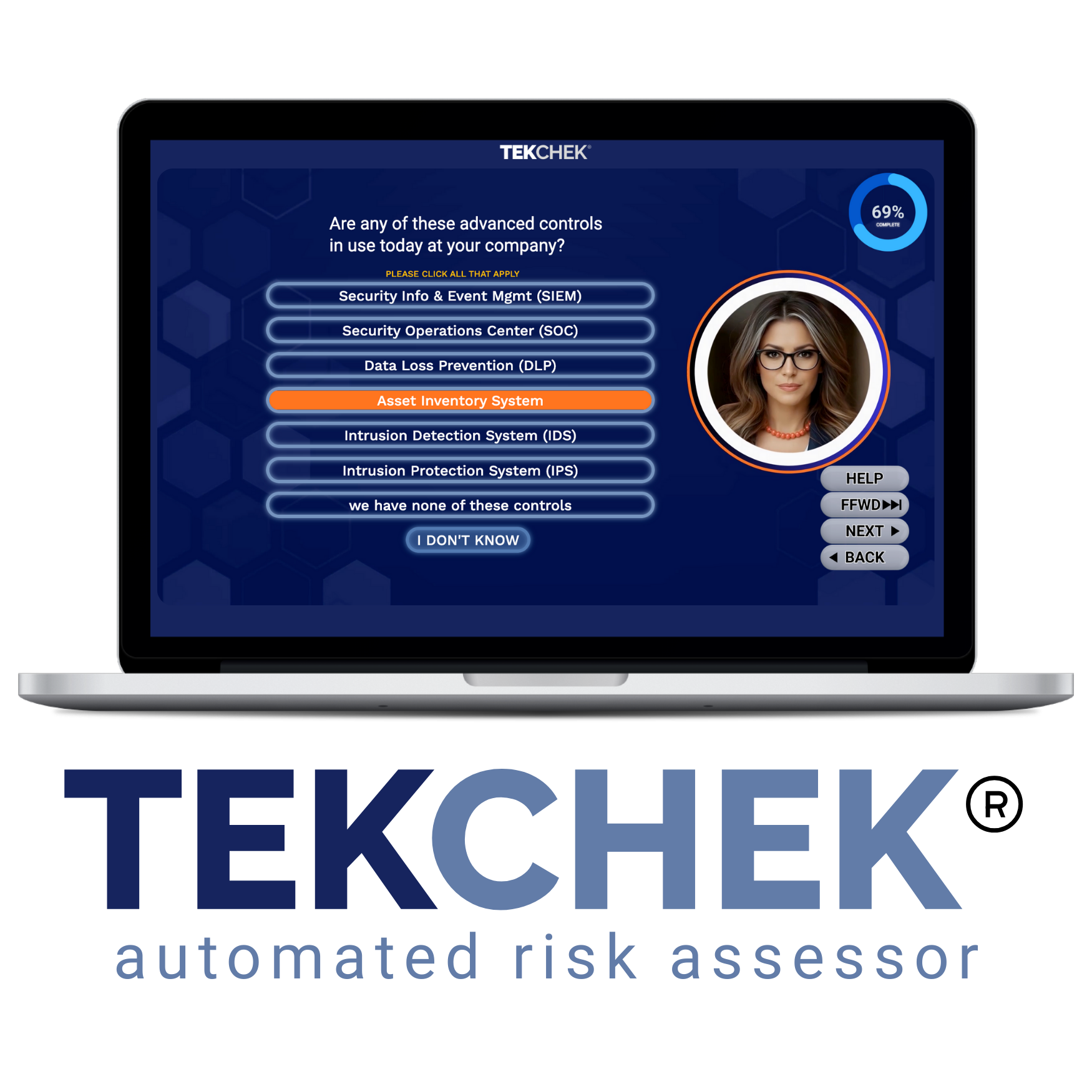
TEKCHEK is a modern, interactive cyber risk assessment platform built to operate at supply chain scale. It allows organizations to assess hundreds or thousands of suppliers concurrently while maintaining speed, consistency, and clarity.
Through a guided, avatar-driven experience, suppliers quickly understand their risks and receive pragmatic recommendations they can act on immediately. This allows supply chain executives to gain the insight needed to strengthen ecosystem-wide cyber resilience.
Key Benefits
Speed – Engage suppliers in under 30 minutes
Ease – Plain-language guidance with real-world context
Convenience – Use any device, anytime, anywhere
Affordability – Designed for large supplier populations
Built for Scale and Global Reach
Unlimited Scalability
TEKCHEK supports supply chains of any size, whether 50 suppliers or several thousand. The platform auto-scales with virtually no limit on concurrent assessments.
Infrastructure is hosted on Amazon Web Services and leverages Cloudflare’s global content delivery network to ensure availability and resilience against bot and DDoS activity.
Global Accessibility
TEKCHEK supports more than 70 languages and offers over 200 AI-driven avatars, enabling suppliers worldwide to participate in the language they know best.
From Third-Party Risk to Collective Resilience
Manufacturing supply chains cannot eliminate cyber risk entirely. The goal is not perfection. The goal is visibility, prioritization, and cyber resilience across the ecosystem.
By enabling consistent third party risk management, organizations can reduce systemic exposure, satisfy regulatory expectations, and build trust across their supplier networks.
Work with tekrisq
tekrisq helps small and mid-sized businesses understand application security as part of a broader, risk-based cybersecurity strategy.
Rather than focusing only on tools, tekrisq evaluates how applications are built, deployed, and maintained. Application security risks are often uncovered during a vulnerability assessment, helping organizations prioritize remediation based on real-world impact.
Learn more about tekrisq and how we support organizations:
To discuss your information security posture or schedule a consultation.


